
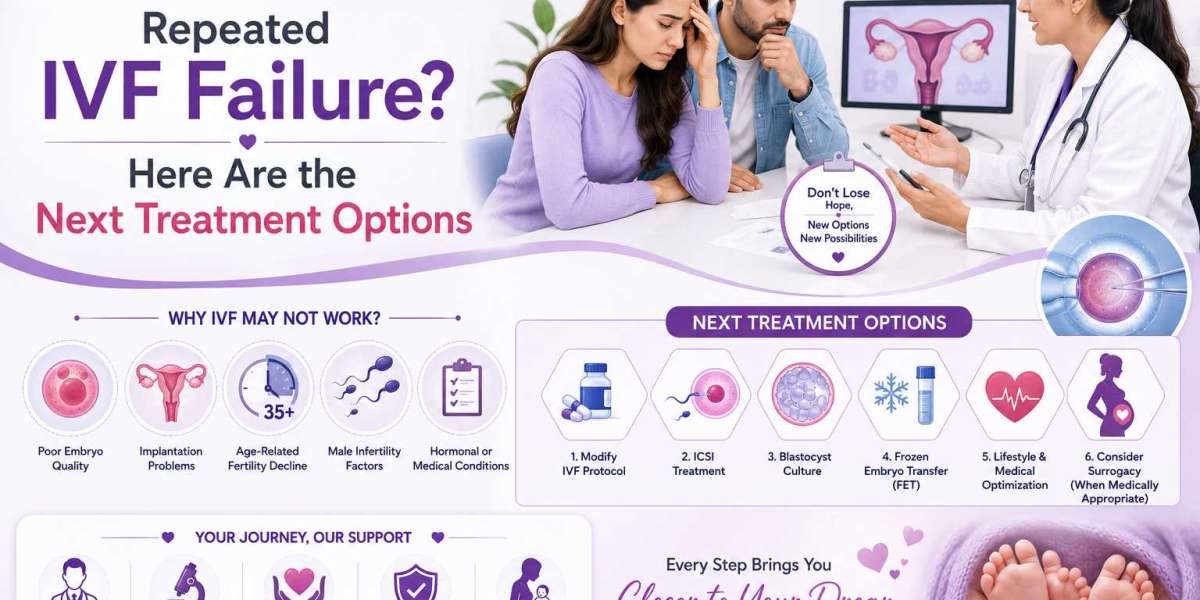
Experiencing repeated IVF failure can be emotionally and physically challenging for couples who dream of becoming parents. While IVF treatment has helped millions of families worldwide, not every IVF cycle results in a successful pregnancy. If you have undergone multiple unsuccessful IVF attempts, it does not necessarily mean that parenthood is out of reach. Modern reproductive medicine offers several advanced diagnostic tools and treatment options that can help identify the underlying cause and improve your chances of success.
Understanding why IVF has not worked and exploring the next steps with an experienced fertility specialist can make a significant difference. In this article, we discuss the common reasons for repeated IVF failure and the treatment options available for couples seeking successful fertility treatment.
What Is Repeated IVF Failure?
Repeated IVF failure generally refers to the inability to achieve a successful pregnancy after multiple embryo transfers using good-quality embryos. Every case is unique, and there is no single definition that applies to all patients. Instead of repeating the same treatment protocol, fertility specialists usually recommend a detailed evaluation to identify factors that may have been overlooked.
A recent case highlighted how a couple achieved a successful pregnancy after three failed IVF cycles when specialists discovered previously undiagnosed reproductive issues and created a more personalized treatment plan.
Common Reasons for Repeated IVF Failure
Several medical and biological factors may reduce the chances of a successful IVF cycle.
1. Poor Embryo Quality
Embryo quality is one of the most important factors influencing IVF success. Chromosomal abnormalities, poor egg quality, or sperm-related issues may prevent embryos from developing normally or implanting successfully.
2. Implantation Problems
Even healthy embryos may fail to implant if the uterine lining is not receptive or if underlying uterine conditions are present.
Possible causes include:
- Thin endometrium
- Uterine polyps
- Fibroids
- Scar tissue
- Congenital uterine abnormalities
3. Age-Related Fertility Decline
As women grow older, both egg quality and egg quantity naturally decline. This increases the risk of chromosomal abnormalities and reduces implantation potential.
4. Male Infertility Factors
Male fertility also plays a significant role in IVF outcomes.
Problems such as:
- Low sperm count
- Poor sperm motility
- DNA fragmentation
can affect embryo development even when fertilization occurs successfully.
5. Hormonal or Medical Conditions
Underlying medical conditions may interfere with pregnancy.
Examples include:
- PCOS
- Thyroid disorders
- Endometriosis
- Autoimmune disorders
- Diabetes
Treating these conditions before another IVF cycle may improve outcomes.
What Should You Do After Repeated IVF Failure?
Instead of immediately repeating another IVF cycle, fertility specialists usually recommend a comprehensive fertility assessment.
This may include:
- Hormonal testing
- Uterine evaluation
- Advanced semen analysis
- Embryo quality assessment
- Genetic testing where clinically appropriate
- Review of previous IVF protocols
A personalized evaluation helps determine the most effective next step rather than repeating the same treatment approach.
Next Treatment Options After Failed IVF
1. Modify the IVF Protocol
Sometimes small adjustments can improve success.
Your fertility specialist may recommend:
- Different ovarian stimulation medications
- Individualized hormone protocols
- Improved embryo transfer timing
- Optimized medication support
Personalized IVF protocols often produce better results than repeating identical treatment cycles.
2. ICSI (Intracytoplasmic Sperm Injection)
If male infertility contributes to repeated IVF failure, ICSI treatment may improve fertilization rates by injecting a single healthy sperm directly into the egg.
ICSI is commonly recommended for couples with severe male infertility or previous fertilization failure.
3. Blastocyst Culture
Growing embryos to the blastocyst stage before transfer allows specialists to select embryos with stronger developmental potential.
Blastocyst transfer may improve implantation rates in carefully selected patients.
4. Frozen Embryo Transfer (FET)
Frozen Embryo Transfer (FET) enables embryo transfer in a later cycle when the uterus may be better prepared for implantation.
Many fertility specialists recommend FET after repeated IVF failure depending on the patient's medical condition.
5. Lifestyle and Medical Optimization
Improving overall health may positively influence fertility.
Recommendations may include:
- Maintaining a healthy weight
- Managing chronic illnesses
- Improving nutrition
- Reducing stress
- Avoiding smoking and excessive alcohol
- Correcting vitamin deficiencies
These measures support reproductive health alongside medical treatment.
6. Consider Surrogacy When Medically Appropriate
For some intended parents, repeated IVF failure may result from conditions that prevent successful implantation or make pregnancy medically unsafe. In such cases, surrogacy in India may be considered if the patient meets the eligibility requirements under the Surrogacy (Regulation) Act, 2021 and the ART (Regulation) Act, 2021. Eligible medical situations include recurrent implantation failure, absence of the uterus, repeated pregnancy loss due to specific medical causes, or other conditions where carrying a pregnancy is not possible.
Why Choosing the Right Fertility Centre Matters
Repeated IVF failure requires more than simply repeating treatment—it requires careful investigation, individualized planning, and access to advanced reproductive technology.
A trusted fertility centre should provide:
- Experienced fertility specialists
- Modern IVF laboratories
- Advanced embryo techniques
- Transparent communication
- Ethical medical practices
- Personalized treatment plans
These factors play an important role in improving treatment outcomes.
Why Choose Surrogacy Centre India?
Surrogacy Centre India is one of India's trusted fertility centres, offering comprehensive reproductive care under one roof. Established in 2009, the centre provides advanced IVF treatment, ICSI, IUI, male and female infertility treatment, blastocyst culture, frozen embryo transfer, surgical sperm retrieval, fertility preservation, and legally compliant altruistic surrogacy. The clinic follows a patient-first approach while complying with the Surrogacy (Regulation) Act, 2021 and the ART (Regulation) Act, 2021.
With 15+ years of experience, 8,000+ ART babies, patients from 55+ countries, and centres in New Delhi, Noida, and Gurugram, Surrogacy Centre India combines advanced reproductive technology with compassionate, personalized care. Every treatment plan is tailored to the patient's unique medical needs, ensuring transparency and expert guidance throughout the fertility journey.