
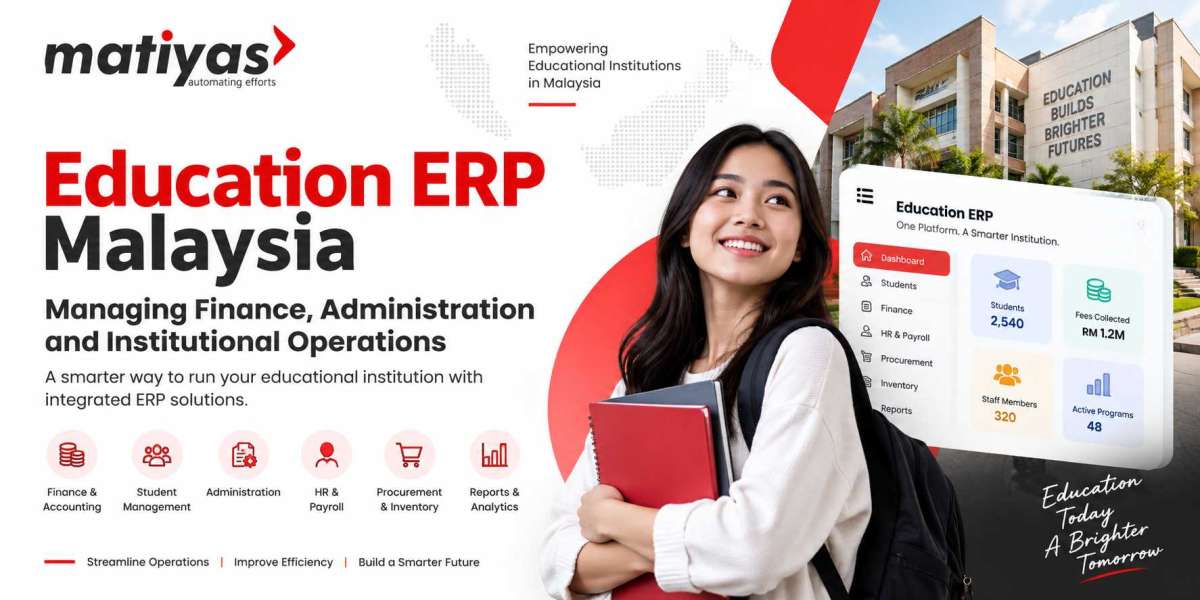
Education ERP Malaysia: Managing Finance, Administration and Institutional Operations
Educational institutions in Malaysia are managing increasingly complex administrative, financial and operational requirements. Schools, colleges, universities, training centres and other education providers often need to coordinate student records, fee management, accounting, procurement, human resources, inventory and reporting across multiple departments.
When these activities are managed through disconnected software, spreadsheets and manual processes, institutions can face duplicated data, delayed reporting and limited visibility into day-to-day operations. This is where Education ERP Malaysia solutions can provide a more integrated approach by bringing key institutional processes together on a centralized platform.
Malaysia's higher education digitalisation strategy for 2025–2030 places emphasis on data infrastructure, automation, digital capabilities and data-driven decision-making, making integrated technology increasingly relevant for educational institutions.
What Is Education ERP Software?
Education ERP software is an integrated business management system designed to connect the administrative, financial and operational functions of an educational institution.
Unlike a system that focuses only on student records or academic activities, an ERP platform can connect areas such as finance, procurement, HR, payroll, inventory, assets, admissions and institutional reporting.
For Malaysian educational institutions, an Education ERP Malaysia solution can help create a centralized source of operational information. Instead of different departments maintaining separate spreadsheets or applications, authorized users can work with connected data and standardized workflows.
This is particularly useful for institutions with multiple departments, campuses, programs or administrative teams.
Why Malaysian Educational Institutions Need ERP
Managing an educational institution involves much more than teaching and learning. Administrative teams must handle financial transactions, staff information, purchasing, assets, student-related processes, reporting and internal approvals.
A systematic review of financial management in Malaysian educational institutions highlights both challenges and opportunities associated with educational technology and financial management.
An ERP system for education can help address these challenges by connecting business processes instead of treating each department as an isolated function.
For example, when procurement, inventory and finance operate through connected workflows, management can gain better visibility into purchases, expenses and available resources.
Key Features of Education ERP Malaysia Solutions
Finance and Accounting Management
Financial management is one of the most important components of an education ERP system.
Educational institutions may need to manage budgets, expenses, invoices, payments, receivables, payables and financial reports. An integrated education ERP software solution can bring these activities into one centralized financial environment.
Finance teams can use ERP capabilities to monitor transactions, organize financial records and generate reports for management review.
For institutions handling multiple departments or campuses, centralized financial information can also make it easier to monitor financial activity across different operational units.
Student Fee and Payment Management
Fee collection is another important administrative activity for schools and higher education institutions.
An education ERP platform can help institutions manage student-related billing, invoices, payment records and outstanding amounts. This can reduce the need for finance teams to manually reconcile information from different sources.
A connected fee management process can also provide administrators with better visibility into receivables and payment status.
Human Resource and Payroll Management
Educational institutions depend on teachers, lecturers, administrative employees, support staff and other personnel.
An ERP for educational institutions can connect employee records with HR and payroll processes. Depending on the institution's requirements, the system may support employee information, attendance, leave management, payroll processing and related administrative workflows.
Centralizing employee information can reduce duplicate data entry and give authorized HR teams a consistent view of workforce information.
Procurement and Purchase Management
Schools and colleges regularly purchase educational materials, office supplies, equipment, technology, maintenance services and other resources.
With education ERP software, institutions can organize purchase requests, approvals, purchase orders, supplier information and related financial transactions within connected workflows.
This can make procurement easier to monitor while providing management with greater visibility into institutional spending.
Inventory and Asset Management
Educational institutions manage a wide range of physical resources, including computers, laboratory equipment, furniture, books, teaching materials and other assets.
An ERP system can help maintain centralized records of inventory and assets. Institutions can track relevant information, monitor stock levels and improve accountability for resources.
For organizations operating multiple campuses or facilities, centralized inventory management can also provide better visibility across locations.
Administrative Operations With Education ERP
Administration often involves repetitive activities that consume significant staff time. Manual data entry, document handling, approvals and reporting can create bottlenecks when information is distributed across multiple systems.
The Malaysian higher education digitalisation action plan specifically highlights automation of core academic and administrative functions as part of digital transformation.
An Education ERP Malaysia implementation can support this direction by automating selected workflows and connecting information between departments.
For example, an approval workflow can move a request from an employee to the appropriate manager and then to the finance or procurement team without requiring every department to maintain separate records.
Centralized Data for Better Institutional Management
One of the major advantages of an ERP system for education is centralized information.
When finance, HR, procurement, inventory and administration use disconnected systems, management may need to combine information manually before making decisions.
A centralized ERP environment can provide authorized users with access to more consistent institutional information.
This also creates opportunities for dashboards and analytics. Malaysia's higher education digitalisation framework identifies data analytics as an important component for generating actionable information and supporting decision-making.
Education ERP for Multi-Campus Institutions
Institutions operating multiple campuses or branches may face additional administrative complexity.
Each location may have different staff, expenses, inventory, purchasing requirements and operational activities. Without centralized systems, consolidating this information can take considerable administrative effort.
A Malaysia education ERP platform can provide centralized oversight while allowing individual departments or campuses to operate according to defined roles and permissions.
This can help management monitor institutional performance without requiring every operational activity to be managed from a single physical location.
Improving Reporting and Decision-Making
Reporting is an important part of institutional management.
Management may need information about expenses, budgets, procurement, staffing, inventory, student-related financial activity and other operational areas.
An integrated Education ERP Malaysia solution can make reporting more structured by collecting information from connected processes.
Instead of depending entirely on manually prepared spreadsheets, administrators can use system-generated reports and dashboards based on available institutional data.
This can support faster analysis and help decision-makers identify operational issues that require attention.
Choosing the Right Education ERP Malaysia Solution
Educational institutions should evaluate ERP software based on their actual operational requirements rather than selecting a platform simply because it offers a large number of features.
Important considerations include scalability, financial management, HR capabilities, procurement, inventory, reporting, user permissions, integration capabilities and implementation support.
Institutions should also consider how easily the software can adapt to their existing workflows.
A successful ERP implementation requires more than installing software. It involves understanding existing processes, preparing data, defining user roles, configuring workflows and training employees.
Research on ERP adoption in higher education also identifies implementation challenges and success factors as important considerations for institutions evaluating ERP systems.
How Matiyas Solutions Can Help
Matiyas Solutions can help educational institutions evaluate and implement ERP solutions based on their specific operational requirements.
Instead of treating finance, administration, HR, procurement and inventory as completely separate processes, Matiyas Solutions can help businesses and institutions explore an integrated ERP approach designed around their workflows.
For Malaysian educational institutions looking to improve financial visibility, streamline administration and connect institutional operations, an ERP implementation can provide a structured foundation for digital transformation.
If your school, college, university or education organization is evaluating Education ERP Malaysia solutions, contact Matiyas Solutions to discuss your requirements and explore an ERP approach suited to your institution's operational needs.
Conclusion
Educational institutions require efficient systems to manage more than academic activities. Finance, administration, procurement, HR, inventory, assets and reporting all contribute to the effective operation of an institution.
An Education ERP Malaysia solution can bring these functions together through centralized data, connected workflows and structured reporting. For institutions looking to reduce fragmented processes and improve operational visibility, ERP can become an important part of their broader digital transformation strategy.
As Malaysian educational institutions continue moving toward stronger digital infrastructure, automation and data-driven management, choosing an ERP system that can scale with institutional requirements can help create a more connected and manageable operational environment.


